
How ‘To Use a Mountain’ Documents America’s Decades-Long Nuclear Waste Battle
A new documentary is putting a human face on one of the United States’ longest-running environmental disputes: the decades-long search for a permanent home for the nation’s nuclear waste. Directed by filmmaker Casey Carter, To Use a Mountain traces how the burden of storing America’s most dangerous waste ultimately fell on land considered sacred by Native American communities, reframing the story as one of what campaigners describe as environmental violence against indigenous people.
The film opens with the passage of the Nuclear Waste Policy Act in 1982, a law that set off a federal mandate to isolate the country’s nuclear waste for 10,000 years. In response, the US Department of Energy identified six rural communities across the country as candidate sites for the waste, mapping and analysing each location through a purely bureaucratic lens. Carter has said the project first took shape while he was researching Yucca Mountain, the Nevada site eventually chosen to house the waste, during his graduate studies in architecture. He came across a trove of government documents examining the other five candidate sites, most of which had faded from public memory, and was struck by how completely the human stories behind these places had been erased from the official record.
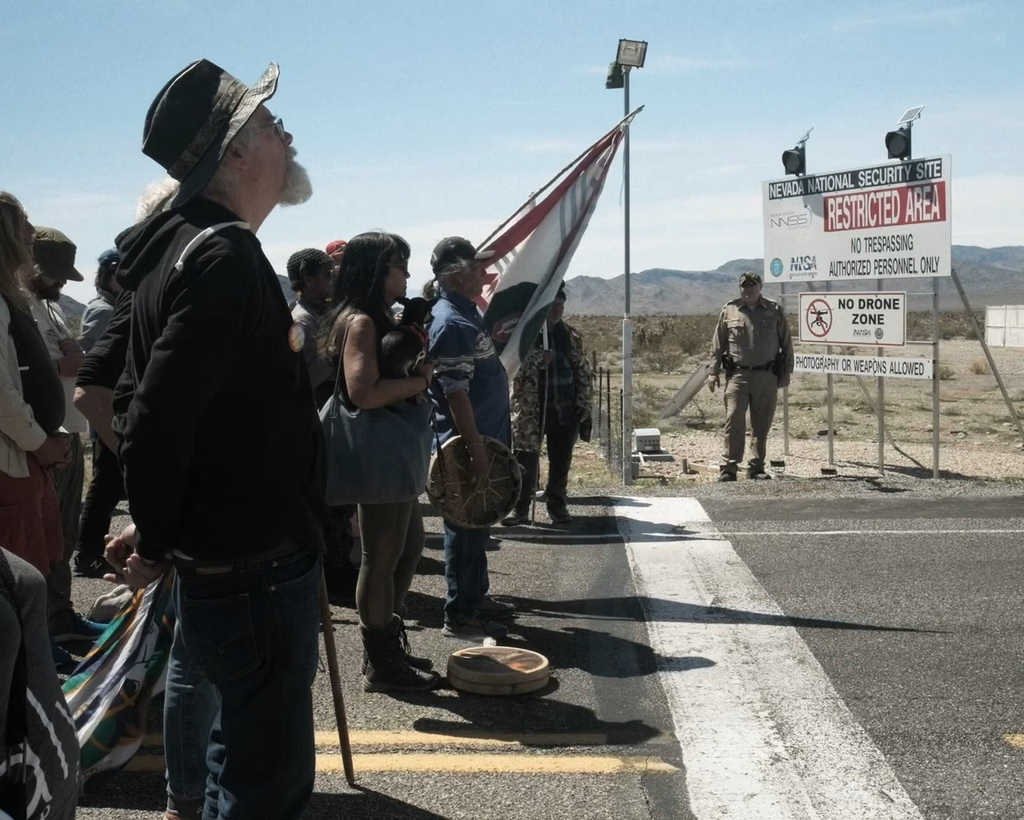
That gap between bureaucratic analysis and lived experience became the emotional core of the film. To Use a Mountain follows farmers, miners, citizen scientists, Native American leaders and activists across the various candidate sites, weaving together landscapes, personal testimony and archival material to contrast the cold logic of government process with the communities left to grapple with its consequences. Among those featured is Ian Zabarte, a political activist and member of the Shoshone Nation of Indians, who speaks to how the US government has failed to honour its original treaty obligations to the Shoshone people over the land in Nevada that ultimately became Yucca Mountain.
The site selected in the end, a desert ridge in Nevada, sits on the unceded ancestral lands of the Western Shoshone and Paiute tribes, not far from where the United States once conducted nuclear weapons tests. Although construction at Yucca Mountain was eventually halted amid decades of legal and political controversy, no permanent solution has since been found for the roughly 90,000 tons of high-level nuclear waste the country continues to produce and store.
Carter has said the film also touches on communities beyond Nevada that carried their own burdens even before nuclear waste entered the conversation, including areas in Mississippi and Louisiana already grappling with chemical and heavy-metal contamination from industrial plants, only to later learn their land was also under consideration as a nuclear waste site. He has noted that constraints on the film’s runtime meant some of these stories could only be told in part.
To Use a Mountain had its world premiere in April 2025 at the Visions du Réel festival in Switzerland, where it won a Special Jury Award in the International Feature Film Competition, before going on to screen at festivals including the Dallas International Film Festival, DOXA in Vancouver, Big Sky and IDFA’s ParaDOXA Forum. The film opened theatrically at DCTV in New York in August 2026, with a wider regional theatrical rollout to follow and a video-on-demand release planned for 2027.
Carter has pointed to the film’s growing relevance amid renewed political and industry interest in nuclear power, driven in part by the rising energy demands of the artificial intelligence data centre boom, as well as a renewed push under the current US administration to revive the long-stalled Yucca Mountain project. For Carter, the film stands as a record of resistance and stewardship, insisting that the human and environmental costs of nuclear waste disposal cannot be reduced to government paperwork and technical assessments alone.
About the Author


