
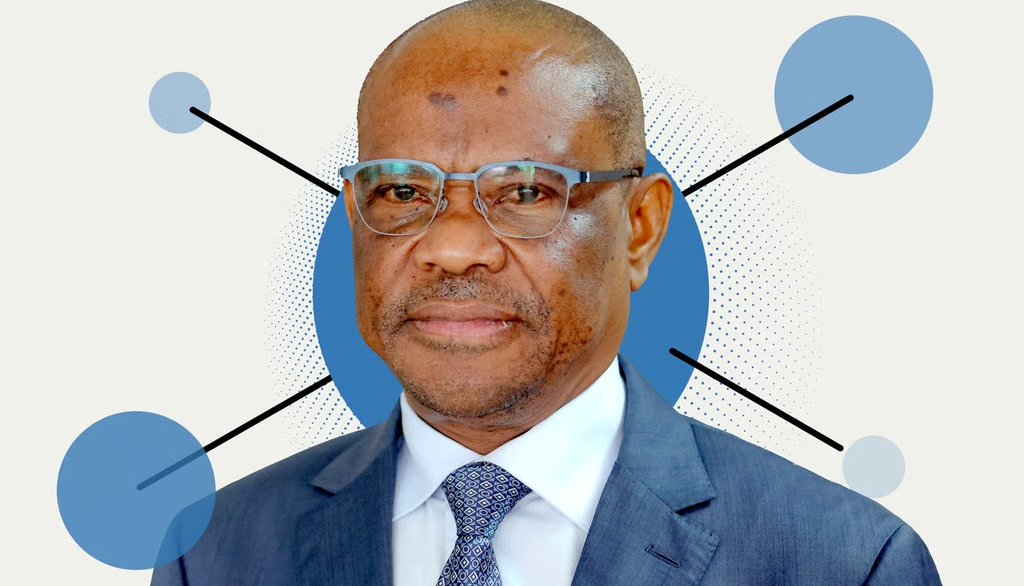
Wike’s Rainbow Coalition Sparks Fear and Fallout Among APC Governors
A political structure built by Nigeria’s Minister of the Federal Capital Territory, Nyesom Wike, is stirring unease within the ruling All Progressives Congress (APC), with reports suggesting some state governors are now exploring alternatives amid growing tension over the coalition’s reach.
Wike has assembled what he calls the Rainbow Coalition, a cross-party political vehicle designed to mobilise support for President Bola Tinubu’s 2027 reelection bid. He has held it up as a model of what he describes as organic, broad-based political unity, pointing to Rivers State as proof of concept and urging other states to replicate it ahead of next year’s polls. But not everyone within the APC shares his enthusiasm.
The disagreement has centred on what the coalition is actually meant to deliver. Wike has consistently maintained that the Rainbow Coalition exists purely to support Tinubu at the presidential level and does not extend to backing APC candidates in governorship or legislative races. That distinction has unsettled a number of APC governors, who worry the arrangement could be used to undercut their own political structures rather than reinforce the party as a whole.
The Progressive Governors’ Forum, led by Imo State Governor Hope Uzodinma, has emerged as a central voice of resistance. While the group’s public resolutions have avoided naming Wike or the coalition directly, the timing and content of their statements have been widely interpreted as a direct response to his activities. In some states, party officials have gone further, openly questioning the coalition’s grassroots strength and organisational capacity to actually deliver votes.
The friction has spread beyond disagreements over structure. APC leaders in the South-East have accused Wike of working to unseat sitting APC governors in the region, rejecting the Rainbow Coalition outright and describing it in one statement as a “chameleon coalition” rather than a genuine party organ. Wike has pushed back forcefully against such criticism, describing opponents within the party as politically lazy and accusing resistant governors of wanting to control the next National Assembly for their own ends.
Perhaps most striking is the reported ripple effect on opposition politics. According to multiple sources, some aggrieved APC governors have begun quietly exploring contact with Atiku Abubakar, the presidential candidate of the African Democratic Congress (ADC), viewing his party as a potential fallback network should their standing within the APC continue to erode. Their concern reportedly stems in part from Wike’s claim that Tinubu has already ceded a number of states to the coalition for the governorship contests, a suggestion that has heightened fears among sitting governors about losing control of their own re-election machinery.
Not all reactions have been hostile. Some political voices have defended the coalition as an asset rather than a threat, arguing that its cross-party appeal strengthens rather than weakens Tinubu’s chances in 2027. Still, with governors in several states reportedly moving to contain or sideline the coalition locally, and whispers of opposition outreach growing louder, the Rainbow Coalition’s role in shaping the ruling party’s fortunes heading into the election looks set to remain a flashpoint well into the campaign season.
About the Author


